
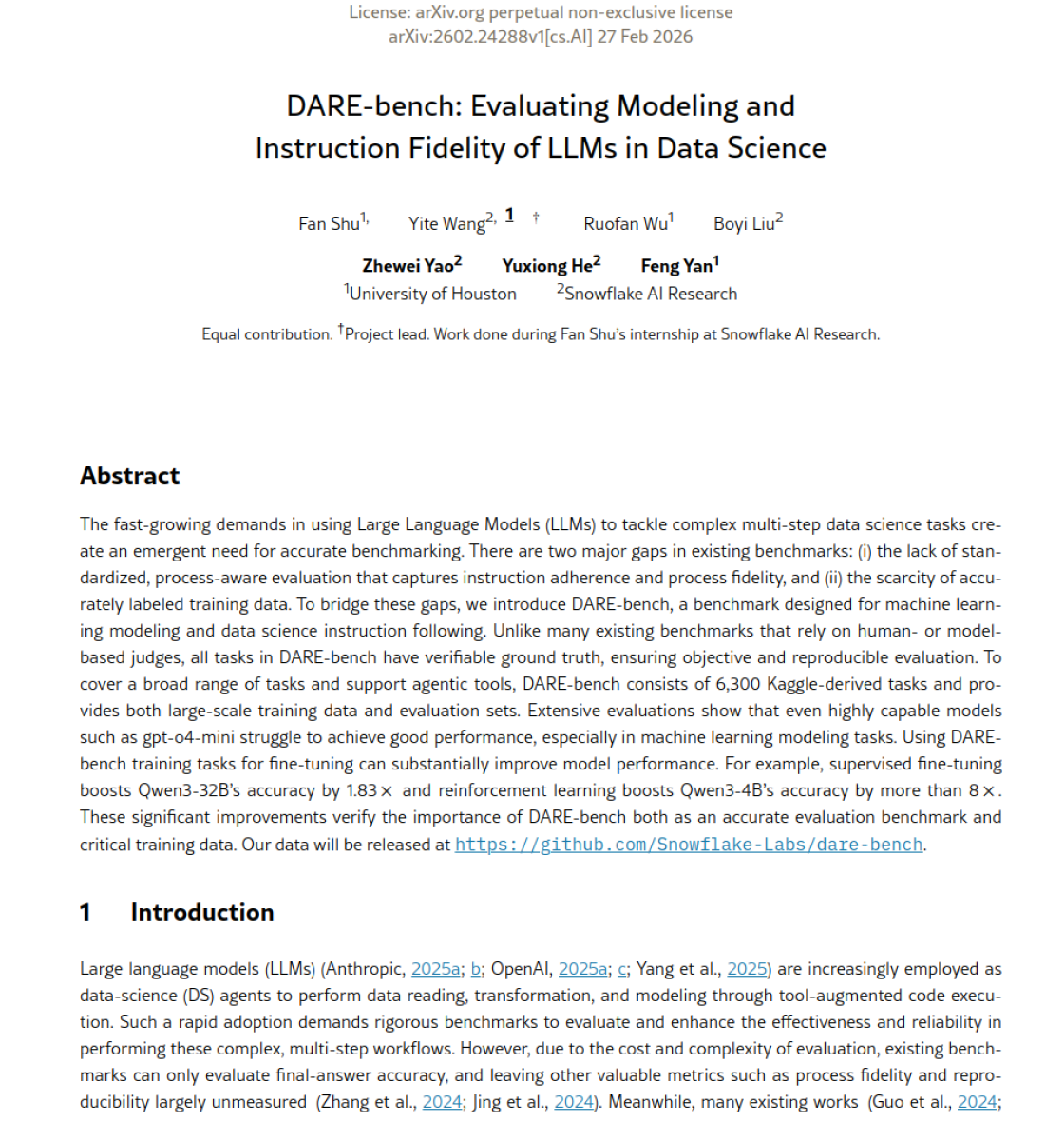
I split this from my Qwen 3.5 piece because the research signal deserves its own spotlight. Two papers stood out immediately: DARE-bench on instruction fidelity and CUDA Agent on high-performance kernel generation.
Research pulse from arXiv
The arXiv queue reinforced the same trend. Papers this cycle are less obsessed with theatrical claims and more focused on evaluation fidelity and optimization behavior.
DARE-bench targets a painful gap many of us feel daily. Models can produce confident notebook prose while quietly missing core instruction constraints. A benchmark that directly tests modeling and instruction fidelity in data science workflows is overdue.
CUDA Agent also stood out. Large-scale agentic RL aimed at high-performance CUDA kernel generation pushes beyond toy tasks. If this line of work keeps improving, we will see agents that do more than autocomplete snippets. They will optimize critical paths where milliseconds and watts actually matter.
Then there are memory and reasoning papers in the same batch. Growing-memory RNN ideas and lightweight theorem-proving agents point to the same long-term goal. Reduce brittle behavior while keeping systems computationally sane. I do not think the winning architecture is one giant monolith. I think it is composable modules with explicit checks and memory boundaries.


World briefing outside core AI feeds
Several non-AI headlines matter because they shape AI adoption conditions. Apple launched a new iPad Air on M4. Better consumer chips quietly expand the practical ceiling of on-device inference. More local throughput means more private assistants, lower cloud dependence, and better offline features.
Health science also delivered a notable milestone with reports around in-utero stem cell therapy progress for fetal spina bifida repair. This is not an AI story by itself, but it does increase demand for trustworthy modeling and decision support in sensitive workflows where errors have real human cost.
And privacy pressure keeps rising. A top HN story around smart-glasses worker visibility concerns highlights the same tension we see everywhere. Sensors are getting better. Data collection is getting easier. Public trust is not automatically following. If product teams treat trust as a legal checkbox instead of a design constraint, backlash will hit hard.
GitHub and open-source signal
Direct GitHub Trending pages were noisy to parse this morning, but adjacent trending results still showed a familiar pattern. Prompt engineering tutorials, lightweight workflow tools, and agent project collections continue to get attention. This fits what we are seeing in communities. People want working recipes they can run today, not only benchmark reports.
I would summarize open-source momentum in one sentence. Practical implementation content is beating abstract thought leadership. If your repo has clear install steps, concrete examples, and realistic hardware notes, it travels. If it reads like a manifesto, it stalls.
What this means for builders this week
If I were running product and engineering this week, I would prioritize four moves.
First, add an on-device fallback for core user actions where possible. Even partial local execution improves resilience and perceived responsiveness.
Second, make fast mode and deep mode explicit in the interface. Users forgive slower answers when the app clearly signals deeper analysis is happening. They do not forgive random lag.
Third, instrument latency by visible turn-time, not only server timings. Your p95 API metric can look fine while the user experience still feels slow because of audio startup, render delays, or multi-step orchestration overhead.
Fourth, run a trust audit before shipping memory-heavy features. Define retention windows. Let users inspect and delete memory. Keep provenance visible when generated output references stored context.
My closing take
I do not think 2026 belongs to whichever lab ships the largest checkpoint. I think it belongs to teams that combine three boring superpowers. Fast interaction. Honest evaluation. Respectful data handling.
The community is already signaling this every day. People reward tools that start quickly, fail clearly, and run where they live. Tiny models are no longer side projects. They are becoming the front door.
So my read for today is simple. The center of AI gravity is not just getting smarter. It is getting closer to the user.
Discover more from TheFlipbit
Subscribe to get the latest posts to your email.